

Greetings from BSG Chairperson Mr. Vishesh Gupta
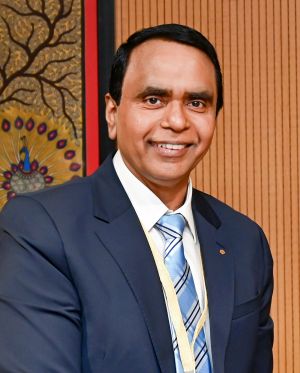
Dear Readers,
Most of us are trying our best to live sustainably. We carry our own bags, hesitate before we discard something, and make small adjustments where we can. Still, these carefully measured choices can seem like they are too small. And sometimes, in the middle of all that trying, a doubt can creep in: does what I do actually change anything?
It is a fair question. Because the systems around us – the city that offers no sidewalks, the building with no place for compost, the market where the ethical option costs twice as much – do not always make sustainability easy. These hiccups are structural, stubborn, and worth naming honestly.
But here is what is also true: the system we inherit today is the behaviour of yesterday, hardened into habit. The author David Peter Stroh wrote in his book Systems Thinking for Social Change: “If you are not aware of how you are part of the problem, you can’t be part of the solution.”
This is the insight at the heart of Sustainable Human Behaviour: the individual has never been irrelevant. To act with awareness, even inside a system that resists you, is to introduce something into it. Our lives are always in an ongoing exchange between the individual and the collective. Each shaping, and shaped by, the other. It is within this exchange that new ways of living can be inspired.
In this issue, we look closely at where progress is shaping up, and where gaps in systems and behaviour continue to slow its wider adoption. In recognizing this, the role we each play becomes clearer.
You will notice that your choices are part of this. So are the doubts you carry. Both are necessary.
Warm Regards
Vishesh Gupta
SGI Vice General Director & BSG Chairperson
Sustainable innovation is no longer something that needs a push. It is visible now in how clean energy is being generated, how mobility is shifting, and how sustainability is entering everyday conversations. In many sectors, there is movement. New technologies are scaling, alternatives are emerging, and public policies are beginning to respond.
But one can still argue that this shift does not always feel complete. That is because change does not move evenly. It builds in parts. Advancing in some areas while slowing in others. The result is a reality where progress is visible, yet not universally available or straightforward to embrace. We’re not seeing a stagnation in progress, but rather a struggle to navigate a complex web of existing systems, ingrained practices, and structural limitations.
Let’s explore some reasons for why these changes might be faltering in their implementation.
|
|
||||
|
|
||||
|
|
||||
|
|
The gap is not simply one of awareness or willingness. The shift becomes real not when options exist, but when they become easier, more reliable, and more widely adopted. On the ground, whether that shift takes hold depends on a range of factors: cost, access, infrastructure, and how systems are designed. These are not things individuals control on their own.
What individuals can control, though, is what we get used to, what we question, and what we start to normalize. The gaps highlighted here are not only failures of infrastructure or policy, they live equally in the choices we make, or don’t. When the relationship between the two is misaligned, progress appears uneven. Visible in parts, but difficult to sustain. For individuals do not simply move within systems; they reinforce them, reshape them, and at times, even disrupt them. It is in this interplay that we continually make the future.

The Tragedy of the Commons
When a resource is shared by everyone, it can get overused because each person acts in their own immediate interest. The classic example is a common grazing field. If every herder adds more cattle to maximise their gain, the land eventually becomes overgrazed and unusable for all. Today, this can be seen in issues like overfishing or air pollution, where individually rational choices add up to collective harm. It is then important for each individual to operate with a conscience that protecting the commons is also protecting the individual. The concept was popularised by Garrett Hardin in 1968.
Source: Garrett Hardin, The Tragedy of the Commons, published in the journal Science (1968).
 To Read

Individual Action vs. Collective Action and the Importance of the Swiss Cheese Model
This article uses the “Swiss cheese model” to explain climate action as a set of overlapping efforts where no single solution is enough, but together they create real impact.

Humans Wiped Out Floreana’s Giant Galápagos Tortoises. Now They’re Bringing Them Back
A powerful example of how systems can cause harm over time, but also how intentional, collective action can begin to repair and rebalance what was lost.

Navigating India’s Climate and Sustainability Transition
This piece offers a nuanced look at how sustainability is not a single solution, but a coordinated process unfolding across multiple layers.
 To See

What is the Tragedy of the Commons?
This engaging animated video by TedEd highlights a key tension: when everyone acts in their own interest, the system can break down for all. At the same time, it points toward solutions rooted in cooperation, rules, and shared responsibility.

How much progress have we made on climate change?
There’s much progress around the world but what is needed to quicken the pace? Find out through the video.
 To Listen

How to cope with climate anxiety – The Climate Question podcast, BBC World Service
Do you also experience climate anxiety? This podcast unpacks the best ways to cope with it.

What’s the impact of war on the climate? – The Climate Question podcast, BBC World Service
Along with the loss of human lives, what’s the climate cost of bombs, jets and destruction of buildings? Find out through the podcast.
 To Play

Can you reach net zero by 2050?
The Climate Game by the Financial Times is a short interactive simulation where you take on the role of a global decision-maker trying to limit climate change. You make choices across energy, transport, food, and policy and quickly see how difficult it is to balance emissions cuts with economic and social realities.
In trying to understand why change, despite being visible, does not always shift everyday life, we are ultimately confronting a deeper question: how does meaningful change actually unfold?
In his dialogue with international law scholar, Ved Nanda, SGI President Daisaku Ikeda describes change as a gradual and pragmatic process. A gradualist approach never loses touch with reality, is responsive to people’s circumstances, and open to continuous adjustment.
“This gradual, pragmatic approach is also a characteristic of following the Middle Way. It is not grounded in self-interests and unilateral perspectives, and is always open to improvement. The bases of this approach are compassion and the bodhisattva way. It calls for sharing in the suffering of others and advancing towards a solution as equals, overcoming each difficulty together one by one—which is why it must be gradual and pragmatic.”
The Buddhist concept of “expedient means,” as explained by President Ikeda, further deepens this understanding. It points to the importance of responding to each situation as it is, adapting approaches based on people’s needs and circumstances, rather than holding on to fixed methods.
“If the people’s circumstances change, then the Buddha’s approach (to communicating the innermost truth) may change. To give an analogy, when a helmsman sets out for a particular destination, he will change his heading, reorienting the sails and the tiller, in response to changing winds. Nevertheless, he invariably succeeds in reaching his destination. The basis for ‘expedient means’ is compassion—an understanding of each individual’s needs at a particular moment.”
In the same dialogue, President Ikeda reflects on human security, where he highlights the importance of strengthening local capacities for self-development. Rather than positioning people as passive recipients of solutions, this approach recognises their inherent ability to respond, adapt, and create value within their own contexts.
“The aim is to create an environment in which people… are not simply being protected but are bringing forth their inherent strength, wisdom, and capacity.”
Seen in this light, progress may not always be understood as something to be introduced from the outside, but about what becomes possible from within. When individuals and communities are supported in ways that allow them to act and respond, they can go from being separate observers to participants. In such a process, they continually learn, adjust, and contribute to what gradually becomes possible, and what eventually becomes the norm.
How I Prioritize Inner Transformation for Climate Action Rakhi Kashyap | Women’s Division | Raipur
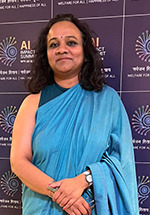
BSGs commitment to the Sustainable Development Goals (SDGs) is rooted in the belief that lasting societal change begins with the inner transformation of individuals. My journey reflects how Buddhist practice, grounded in the concept of Human Revolution, can translate into action across climate resilience, disaster risk reduction, and human-centred development.
I became a voluntary member of BSG in 2015. During my time at Nalanda University, studying Ikeda Sensei’s Peace Proposals became a turning point, shaping my resolve to apply my training in architecture and urban planning toward climate change adaptation and public service. Since then, my work has been guided by the principle that development must uphold human dignity, safety, and resilience—contributing to SDG 11 (Sustainable Cities and Communities) and SDG 13 (Climate Action).
Professionally, I have worked across urban planning and climate–disaster management, contributing to projects on urban resilience, climate-risk assessment, and technology-enabled decision-making. A key milestone was my involvement in India’s first AI-driven climate-tech initiative for disaster preparedness, which received international recognition, including the Paris 2025 AI Award. This reinforced the role of innovation and partnerships in advancing SDG 9 (Industry, Innovation and Infrastructure) and SDG 17 (Partnerships for the Goals).
In 2025, despite this progress, I faced an unexpected professional setback that brought financial and organisational uncertainty. Rather than stepping back, I used this period to deepen my skills, study climate policy and public health, and reflect on my long-term contribution. During this time, I was selected for an advanced course in Climate Change and Public Health at Yale University with a 95% scholarship, strengthening my understanding of the links between climate, health, and equity—key to SDG 3 (Good Health and Well-being) and SDG 10 (Reduced Inequalities).
In early 2026, I took on a senior role with expanded responsibilities in climate and disaster risk reduction. Through sustained dialogue and clarity, I was able to transition back to Delhi, where I now serve as the single-point lead for Climate Change and Disaster Risk Reduction (DRR). My work focuses on integrating climate science, urban planning, and governance to strengthen resilience and reduce risk, particularly for vulnerable communities. This experience has also deepened my understanding of the importance of humane leadership, transparent communication, and institutional accountability—aligned with SDG 16 (Peace, Justice and Strong Institutions).
Throughout this journey, the practice of Soka humanism has been a source of resilience and ethical grounding. It has enabled me to navigate uncertainty, remain accountable in leadership, and continue contributing to the public good. This experience reaffirms that sustainable development is not driven by policy or technology alone, but by individuals who continuously strengthen their sense of responsibility toward society.
My personal determinations moving forward are:
- To advance climate-resilient and human-centred development practices aligned with the SDGs
- To strengthen interdisciplinary approaches linking climate, health, and urban governance
- To contribute professional expertise in service of peace, sustainability, and human dignity
 SDG Tip for Daily Life
Nudge the System
If a place doesn’t offer a sustainable option, ask for it. If a service improves, support it. Systems respond to visible demand.

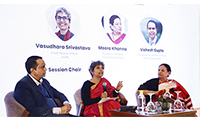
BSG Speaks at Navtika Symposium 5.0 on Integrating SDGs into Early Learning
Bharat Soka Gakkai (BSG) participated as a speaker at Navtika Symposium 5.0, organised by Salwan Education Trust held virtually on 7 February 2026. Representing BSG, Ms. Jaya Rao – Head of External Relations, Media and Sustainability, emphasised giving children agency and moving from awareness to action.
Read more
BSG has now Successfully Held 285 SOHA Exhibitions
The ‘Seeds of Hope and Action (SOHA): Making the SDGs a Reality’ exhibition has travelled to 285 destinations across the country, including: Chandigarh, Amritsar, Jaipur, Delhi, Karaikal, Gangtok, Kalimpong and Hurda, Rajasthan.
Read more
BSG forms the 42nd SDG Club
As part of its mission to foster young SDG ambassadors in Indian schools and colleges, BSG established the 41st and 42nd SDG Clubs in Pallavi International School, Hyderabad and Pallavi Model School, Boduppal.
Read moreContact Us
 Any queries or suggestions regarding the newsletter can be addressed to sdg@bharatsokagakkai.org
 To know more about the ‘BSG for SDG’ initiative, visit the BSG for SDG website
 Download the ‘BSG for SDG’ mobile app with the carbon footprint calculator